Here we are at the end of our unit! My students are currently making some Paper Mache Penguins, our room doesn't have an electronic whiteboard for the moment so we are back to printing out resources... feels a bit like the 1990s!
So here is a printable - a collection of Adelie Penguins so students may paint the markings onto their sculptures correctly.
Penguins

Showing posts with label COGS. Show all posts
Showing posts with label COGS. Show all posts
Monday, December 12, 2011
Wednesday, December 7, 2011
Finding Antarctica: Mapping the Last Continent

In 2011 Australia celebrates 100 years of Australian expeditions to the Antarctic. The Australasian Antarctic Expedition (AAE), which departed from Hobart in December 1911 and was led by Sir Douglas Mawson, was the first Australian-led Antarctic expedition.
In celebration of this centenary, this exhibition will focus on the mapping of Antarctica from the 15th to the 21st century, from crude woodcut maps to the latest satellite imagery. The exhibition will tell the story of the gradual discovery, exploration and charting of this significant land mass.
The exhibition focuses on:
- Early trade and exploration
- Dutch supremacy
- French interests
- James Cook and closer inspection
The exhibition will showcase the magnificent collection of rare maps and charts held by the State Library, accompanied by rare published accounts and original sketches from Antarctica exploration by Cook, d'Urville, the United State Exploring Expeditions and the Australasian Antarctic Expedition.
The Library has an amazing collection of material on the Australasian Antarctic Expedition due to a number of significant acquisitions over the past 100 years. A substantial collection of the official papers of the Expedition team were also deposited with the State Government of New South Wales, in exchange for the State undertaking to publish the remaining records of the expedition team.The records were subsequently transferred to the State Library. A selection of this material will be in display as part of the exhibition.
There is a number of interesting presentations and talks (one on Mawson's forgotten men!), I might just have to attend!


Tuesday, August 2, 2011
Chinese Symbolic Objects

I found a helpful resource page today explaining the symbolic value of motifs on Chinese ceramics.
A fantastic classroom exercise on creating willow pattern plates can be found here.
The willow pattern story helps build background and content knowledge of this beautiful China.
A brief history of Willow Pattern China can be found here.
Wednesday, July 27, 2011
Linkn to COGS - Symbols Systems
Nuwarra Public School has done an excellent job collating resources for Symbol Systems.
Enjoy!
http://www.nuwarra-p.schools.nsw.edu.au/sws/view/1495696.node
Enjoy!
http://www.nuwarra-p.schools.nsw.edu.au/sws/view/1495696.node
Monday, July 25, 2011
Week 2 Reading Task - Modern China - City and Country

This week our reading task focuses on Mondern China - comparing and contrasting the Chinese city and country.
Of course some questions arose during class discussion, here are some links that may assist!
- Education in China - Facts and Figures
- School Life in China - a typical day in a Chinese School with extra links
- Rural School Life in China
- What exactly is a Water Buffalo?
A segment from the BBC Chinese Schools program:
Thursday, June 16, 2011
Moving into Symbol Systems
In Term 2 we will commence our COGS study on 'Symbol Systems' with a focus on China.
To gain an orientation to the topic here are a few interesting websites:
National Geographic Kids has a good overview of facts about China including, geography, nature, history, people and culture, government and economy; along with 'fast facts.'
It also includes a video of how development in Northern China is turning farmland into desert!
An excellent page of China Links suitable for Primary students is here.
To gain an orientation to the topic here are a few interesting websites:
National Geographic Kids has a good overview of facts about China including, geography, nature, history, people and culture, government and economy; along with 'fast facts.'
It also includes a video of how development in Northern China is turning farmland into desert!
An excellent page of China Links suitable for Primary students is here.
Thursday, June 9, 2011
Left vs Right
We are approaching the end of our unit of work government and I have found this excellent diagram explaining the meaning of the 'left and right sides' of politics. Click to enlarge.


Wednesday, June 1, 2011
Electoral Divisions in Australia

Today we looked at current federal electorates in Australia.
We located our local electorate and had a general discussion about our the features of electorates and our leaders.
The up to date federal electorates and corresponding maps are listed here.
Tuesday, May 31, 2011
Monday, May 30, 2011
Australian Protest Songs
I thought it might be nice to finish our successful unit of work on 'Making Informed Choices' with a few protest songs.
Archie Roach - Took The Children Away
Midnight Oil - Beds Are Burning
Yothu Yindi - Jailbreak
">
Protest Song Lyrics
Some information on Australian protest songs during war is here.
Archie Roach - Took The Children Away
Midnight Oil - Beds Are Burning
Yothu Yindi - Jailbreak
">
Protest Song Lyrics
Some information on Australian protest songs during war is here.
Week 6 Focus: Voting
This week we are looking at voting, elections, with a focus on the preferential system of voting used in Australia.
A good, short 1min clip on preferential voting in Australia:
2 rather basic (and sort of funny) videos produced by the Australian Greens for the 2007 election. It is good for students in that it visually explains how preferential voting works.
Of course the Australian Electoral Commission is the first place to look for information on voting in Australia.
An Australian Parliamentary Education Office Factsheet on Elections is here.
How to fill in an Upper House Ballot Paper - (Liberal)
The preferential vote as explained by... Christians! Well explained and easy to understand, supported by diagrams.
Enrol to Vote - Kevin Rudd 07 Ads
A man complains about the size of his Senate ballot paper but explains how to use it to vote.
Finally, A Federal Election 'megamix' of commercials from 1990 - very funny (and a good starting point for election issues.)
A good, short 1min clip on preferential voting in Australia:
2 rather basic (and sort of funny) videos produced by the Australian Greens for the 2007 election. It is good for students in that it visually explains how preferential voting works.
Of course the Australian Electoral Commission is the first place to look for information on voting in Australia.
An Australian Parliamentary Education Office Factsheet on Elections is here.
How to fill in an Upper House Ballot Paper - (Liberal)
The preferential vote as explained by... Christians! Well explained and easy to understand, supported by diagrams.
Enrol to Vote - Kevin Rudd 07 Ads
A man complains about the size of his Senate ballot paper but explains how to use it to vote.
Finally, A Federal Election 'megamix' of commercials from 1990 - very funny (and a good starting point for election issues.)
Thursday, May 26, 2011
National Sorry Day
Today we had a class visit where we discussed the Stolen Generation and the importance of 'Sorry Day' to Australians.
The original 'I have a dream' speech.
The original 'I have a dream' speech.
Saturday, May 14, 2011
Week 4 Focus: The Events That Led to Federation
In Week 4 we are focusing on the events that led to Australian Federation.
To begin, the ABC has a website dedicated to the Centenary of Federation from 2001 which has all kinds of links dedicated to telling the story of Australian Federation. It also includes an excellent overview of Aboriginal perspectives and the journey towards reconciliation and the 1967 referendum.
The ABC's comprehensive explanation of the process of uniting the colonies, establishing the Australian nation:
2 x fantastic 2 minute presentations suited to upper Primary students:
This second presentation focuses a little more on the White Australia Policy and may need some further explaining.
Some important images from Federation:

An invitation to a celebration of the Australian Commonwealth in 1901 from The National Archives of Australia.

Image of the first Commonwealth Ministry from The National Archives of Australia.

Image of the ceremony of the opening of the first Commonwealth Parliament from the National Archives of Australia.

First Australian Prime Minister Edmund Barton's annontated copy of the constitution from 1891 - image from the National Archive of Australia.
An summary of events leading to Federation are found in this essay.
The Australian Government also has an excellent 'Federation: Fast Facts' web page, that includes a link to a Federation Timeline.
The Federation Pavillion is located in Sydney's Centennial Park - a walking distance from our school! You can see it here on this interactive map. The history and heritage of Centennial Park is discussed here. Photos of the Pavilion and a bit of information can be found here.
Finally, this is not exactly relating to Federation, but interesting to children is the 'Australia - A Federation in Stamps' clip.
To begin, the ABC has a website dedicated to the Centenary of Federation from 2001 which has all kinds of links dedicated to telling the story of Australian Federation. It also includes an excellent overview of Aboriginal perspectives and the journey towards reconciliation and the 1967 referendum.
The ABC's comprehensive explanation of the process of uniting the colonies, establishing the Australian nation:
2 x fantastic 2 minute presentations suited to upper Primary students:
This second presentation focuses a little more on the White Australia Policy and may need some further explaining.
Some important images from Federation:

An invitation to a celebration of the Australian Commonwealth in 1901 from The National Archives of Australia.

Image of the first Commonwealth Ministry from The National Archives of Australia.

Image of the ceremony of the opening of the first Commonwealth Parliament from the National Archives of Australia.

First Australian Prime Minister Edmund Barton's annontated copy of the constitution from 1891 - image from the National Archive of Australia.
An summary of events leading to Federation are found in this essay.
The Australian Government also has an excellent 'Federation: Fast Facts' web page, that includes a link to a Federation Timeline.
The Federation Pavillion is located in Sydney's Centennial Park - a walking distance from our school! You can see it here on this interactive map. The history and heritage of Centennial Park is discussed here. Photos of the Pavilion and a bit of information can be found here.
Finally, this is not exactly relating to Federation, but interesting to children is the 'Australia - A Federation in Stamps' clip.
Tuesday, May 10, 2011
Exhibition: From Little Things Big Things Grow

The Museum of Sydney just finished presenting an exhibition called 'From Little Things Big Things Grow.'
This exhibition told the story of a group of Australians, Indigenous and non-Indigenous, who said 'That's not good enough' – and did something about it. The exhibition tells some uncomfortable truths and celebrates some 'ordinary extraordinary' heroes.
I attended the exhibition on the final weekend of showing and was so glad I did - there was so much information availble about the history of voting and citizenship rights for Aboriginal people in Australia.
Here are some photos from my visit!
Please note, if you would like to read the text just double click on each photo and a larger image will appear.
Perhaps you would like to sue this information in the Week 4 component of your Homework Assignment...
The entry to the exhibition:

The explanation at the beginning of the exhibition:

An image of protest:

The 1940s:

The 1950s:
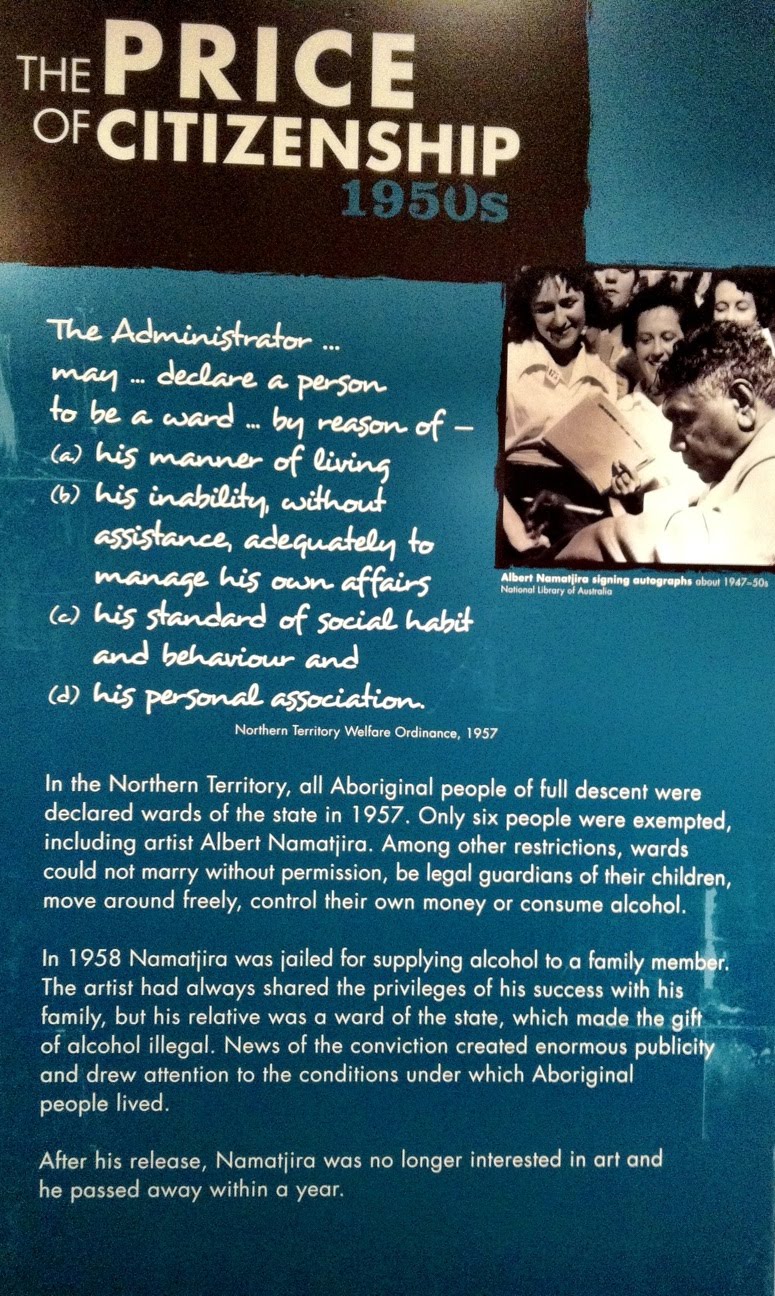
The 1960s:

A voting booth from the time of the referendum:

The Aboriginal tent embassy:

The Freedom Ride:

Aboriginal Citizens called their citizenship papers 'dog tags':

Some information on citizenship:


Monday, May 9, 2011
Becoming an Australian Citizen

The Australian Government - Department of Immigration and Citizenship website has a fun 'Citizenship Ceremony' roleplay on their 'Resources for Schools' webpage.
My class is thinking of using this role play at our next assembly presentation!
Sunday, May 8, 2011
Week 3 Focus: Democracy in Australia
This week our Stage focus is the 'Development of Democracy in Australia,' and the key participants in the process such as Sir Henry Parkes, Edmund Barton and Alfred Deakin.
This comprehensive timeline documents the development of democracy in Australia.
The Parliament of NSW has a more child-friendly timeline and explanation of the events that contributed to federation, as well as an explanation on 'Federation and the Parliament of NSW.'
The National Museum of Australia has a 'Life at the time of Federation' Curriculum materials that are fully downloadable from their website.
This unit of work encourages students to investigate what life was like in Australia at the time of Federation through an examination of a 'time capsule' containing seven key objects used at the time of Federation. Students explore the meaning of these objects to reveal their role in our national identity and their importance in the Federation process.
The Australian Constitution is explained by the Parliamentary Education Office here.
A copy of the Australian Constitution is available here.
The 'Discovering Democracy' website has an amazing array of downloadable material and worksheets appropriate for upper primary students. They are also directly linked to NSW Outcomes. Now I need to go back to school and see if we have the 'video' ;) Can't wait until these websites are all updated with downloadable media.
Here are also some ESL Links that might be worth exploring.
A continent for Federation:
In Search of Democracy - Federation:
Presentation summarising the life and achievements of Sir Henry Parkes:
Actual footage of Australia's Federation Ceremony (silent):
This comprehensive timeline documents the development of democracy in Australia.
The Parliament of NSW has a more child-friendly timeline and explanation of the events that contributed to federation, as well as an explanation on 'Federation and the Parliament of NSW.'
The National Museum of Australia has a 'Life at the time of Federation' Curriculum materials that are fully downloadable from their website.
This unit of work encourages students to investigate what life was like in Australia at the time of Federation through an examination of a 'time capsule' containing seven key objects used at the time of Federation. Students explore the meaning of these objects to reveal their role in our national identity and their importance in the Federation process.
The Australian Constitution is explained by the Parliamentary Education Office here.
A copy of the Australian Constitution is available here.
The 'Discovering Democracy' website has an amazing array of downloadable material and worksheets appropriate for upper primary students. They are also directly linked to NSW Outcomes. Now I need to go back to school and see if we have the 'video' ;) Can't wait until these websites are all updated with downloadable media.
Here are also some ESL Links that might be worth exploring.
A continent for Federation:
In Search of Democracy - Federation:
Presentation summarising the life and achievements of Sir Henry Parkes:
Actual footage of Australia's Federation Ceremony (silent):
Friday, April 29, 2011
Week 2: Student Introduction to COGS Unit
Introduction to COGS Unit - Making Informed Choices - Government
This term our class will be engaged in exploring the concept of Government.
We will work towards developing an understanding of how making decisions affects all aspects of our lives.
We will be learning about aspects of Government and Democracy, including the three levels of government in Australia. We will learn about the Australian system of voting and the history of important figures in the development of democracy both in Australia and around the world.
We will develop knowledge on how a law is made and how representatives, such as our Local Mayor, State Premier and Prime Minister are elected.
By analysing and valuing different perspectives we are able to make informed choices and contribute to the democratic process.
This term our class will be engaged in exploring the concept of Government.
We will work towards developing an understanding of how making decisions affects all aspects of our lives.
We will be learning about aspects of Government and Democracy, including the three levels of government in Australia. We will learn about the Australian system of voting and the history of important figures in the development of democracy both in Australia and around the world.
We will develop knowledge on how a law is made and how representatives, such as our Local Mayor, State Premier and Prime Minister are elected.
By analysing and valuing different perspectives we are able to make informed choices and contribute to the democratic process.
Thursday, April 28, 2011
Week 2 Focus: Early Democracy
This week we are looking at the history of people empowering themselves to have a say.
The Wikipedia article on the 'History of Democracy' is quite comprehensive and includes information on:
The BBC Primary History page fantastic information about Ancient Greece.
The BBC 'Big Ideas That Change The World - Democracy' series presented by British ex MP Tony Benn is some seriously interesting viewing - professional and clearly delivered. Is more suitable for upper students.
A concise and appropriate Australian video discussing the birth of democracy is here:
A great 3 minute video introduction to 'Democracy' - (American presentation of Ancient Greece, active citzenship, foundations for democratic government, majority rule with minority rights, constitution, right to vote.)
Finally, a fun 1945 Encyclopedia Brittanica presentation on 'What is Democracy.' Enjoy!
The Wikipedia article on the 'History of Democracy' is quite comprehensive and includes information on:
- Mesopotamia
- India
- Sparta
- Athens
- The Roman Republic
The BBC Primary History page fantastic information about Ancient Greece.
The BBC 'Big Ideas That Change The World - Democracy' series presented by British ex MP Tony Benn is some seriously interesting viewing - professional and clearly delivered. Is more suitable for upper students.
A concise and appropriate Australian video discussing the birth of democracy is here:
A great 3 minute video introduction to 'Democracy' - (American presentation of Ancient Greece, active citzenship, foundations for democratic government, majority rule with minority rights, constitution, right to vote.)
Finally, a fun 1945 Encyclopedia Brittanica presentation on 'What is Democracy.' Enjoy!
Subscribe to:
Posts (Atom)